Change Log: Second Iteration (9/25/25)
- Trainer 117

- Sep 26, 2025
- 19 min read
As explained last time, the Big Idea for Goon Game is to create a system that encourages player expression within a given play style. To that end, several systems have been added, overhauled, or completely altered to move closer to that Big Idea. Those changes, and the order in which I will discuss them, are as follows:
Reworked Main and Sub-Objectives; baking the former into each player faction while leaving the latter on the board, and the only place desirable resources spawn naturally.
Changed the board layout to fit within the new Objective rework and the new Obstacle system.
Added Obstacles that the players place at the start of play and that can be moved during play with special spells or abilities.
Reworked Actions and Free Actions to create better distinctions between the two sets of actions.
Added Conditions as shorthand for buffs or debuffs, hopefully making it easier for players to understand, apply, and remove hindrances to their or their opponent’s game plan.
Separated Reverbs into categories so that players can reference the various cards in the deck faster.
Added new Reverbs in accordance with player feedback.
Altered existing Reverbs in accordance with player feedback.
Cut certain Reverbs in accordance with player feedback.
Focused Factions closer to their desired roles with changes based on player feedback.
Brawl can now move around the board faster while attacking, allowing them to apply pressure more effectively.
Swarm has more incentive to take Objectives and contest Automatons, as they create new Sub-Objectives when AI Spawners are removed and gain immunity to Reverbs while standing on a controlled objective.
Plot has more incentive to mess around with the Reverb deck as their Commander can now exclude players from their effects by paying Mana.
Units within all factions were altered to suit their respective play style better. While still adhering to their respective class archetype.
Spell hands were made smaller so as not to overwhelm players.
Spells were reworked to be a finite resource that players don’t have immediate access to. However, they can still plan around it if it aligns with their main gameplay objectives.
Empowerment was added, allowing players to see more of the top of their deck and draw more than one card if they play into their faction’s strengths round after round.
Larger spell decks were made for each faction, with some commonality. But in various amounts to create a stronger faction identity.
Reworked Main and Sub-Objectives
Originally, these were both variable; set during the start of play or spawned in certain locations, dependent on the map. However, in this early stage, I noticed that these two kinds of Objectives were too similar. Both gave out the same rewards, both were limited by the pool of rewards tied to them, and both were placed in telegraphed spots on the map. The only real difference between them was pool size and duration, something players didn’t really notice; choosing instead to ignore Sub-Objectives and B-line for Main. The way Automatons (the AI player) behaved may have also factored into this single-minded mentality, as they were geared in a way to deplete Objectives as fast as possible, and given where they spawned, their priority target was Main. This led all three players to adopt similar play styles, as they each rushed down to Main to try to fight over the remaining resources. In essence: the desired outcome, in practice: not so much.
While players were encouraged to interact and fight each other and the AI for resources, none of them had the room to fully implement their individual game plans. The closest a player came was Plot, who was using his faction’s ability to draw more Reverbs, but wasn’t removing or adding Reverbs with his Stack the Deck ability, which gives Plot more control over what Reverbs come into play. The conditions for the Final Round, the game’s closing round, restricted players as well, as the Automatons triggered it themselves before anyone could set up.
I want players fighting over these map locations. But I also don’t want them blocked out of scoring or building momentum by merely being locked out of an objective. Nor do I want all players to feel like they need to directly engage in combat to gain any kind of foothold. I’ve made several changes to the objectives to help address these pain points.
For starters, the Main Objectives are now a part of individual factions and are more closely tied to their faction identity. In previous versions, players could only score VP by taking resources from an objective. But now, each player has a set of Missions that reward VP when completed and that persist throughout play, so players always have the means to score, even if they are locked off objectives.
| Chimera Core | The Immortal Sun Empire | Creatures of Havoc |
Missions | Gain 1 VP for every player-controlled unit you KO.
Gain 2 VP for every player-controlled unit you remove from play. | Gain 1 VP for every Sub-Objective you take.
Gain 2 VP for every Automaton unit destroyed. | Gain 1 VP for every Distortion or Complication Reverb drawn from the Reverb deck.
Gain 2 VP for every Plot Reverb drawn from the Reverb deck. |
These missions, hopefully, will give players not only something to strive towards. But also help guide them to long-term goals by providing short-term objectives that play into their faction's strengths.
Sub-Objectives are still on the map, like before, but I’ve dropped the two types of Sub-Objectives in favor of having just one. That change also altered how players take resources from a Sub-Objective. Before, you either had to control the objective to gain points or you had to spend a free action to take resources from the objective. Now, only the pool objectives remain — but, if you do not control an objective, you have to use an Action to take resources. Only the faction that controls an objective can take resources with a free action.
Hopefully, with these changes, players will be more incentivized to use more of their faction’s tool kit; as well as make for more interesting plays as players fight over these objectives, or plot to deplete them without getting caught by other players.
Changed the board layout
I talked about this somewhat in my “Creative Constraints” post, so I’ll be brief with this one. Long and short of it, with the changes made with Objectives above, the old board layout would be antithetical to the new rules I wanted to test going forward. Combined with the printing limitations of game boards, I settled on reducing the overall size of the game board as well as removing any permanent fixtures on the board for reasons I will discuss in the next section.

But this was also rooted in a player concern over unit range: namely, being unable to get into the proper position due to the lack of movement. Now, this player in particular was playing Brawl, which is the more rushdown faction, so I focused on giving that faction more movement utility while making the board smaller so all players could better move about; without having to increase anyone's movement stat.

Added Obstacles
A change recommended by my play testers was to focus on creating and distorting the line of sight with cover. To them, what cover was on the board didn’t have enough utility to factor into any given strategy. As there wasn’t a need to break the line of sight, nor was the cover placed in a way that it could create interesting choke points.
This problem was at the forefront of my thinking when redesigning the board. Yes, I needed to make changes to accommodate the modifications made to the Objectives to make them work. But that was the easy part, those were the constants; eight 3x3 boxes plopped onto the map in sensible spaces — but what goes in the spaces between? Then it hit me. One thing my play testers really enjoyed about the previous build of Goon Game was the uncertainty Reverbs added to each turn. To them, these were good shake-ups that (for the most part) shifted the current state of play and made opportunities for them to push in on their opponents. What’s more, they made each game somewhat unique. So why not leave the board blank, apart from the objectives, and let the players populate the play space?


Now, cover is a part of strategy because it's placed in the hands of the player. How it works is, during setup, players take turns placing one of the fourteen obstacles onto the board, starting with the player who will go last when gameplay starts. Obstacles can’t be placed in a player’s spawn, nor can they touch another obstacle more than once, and only by the corners. This way, the board can change game to game, and with how the halves of the board are set up, players can also change where the objectives are placed, to some degree. Creating variant conditions in each game for players to consider.
Currently, there are five types/shapes of Obstacles: the classic Tetris pack. Separated as such in a future-proofing measure, as I’d like to add more spells and abilities that alter the placement of Obstacles as well, adding another layer to their utility. But for now, I first need to see how players react to this modular system in the first place before I dig any further with this idea.
Changed Actions and Free Actions.
In the beginning, Free Actions were created so players knew that interacting with game systems, like picking up or trading resources, could be done in addition to their action on a given activation. However, this proved to powerful, allowing for all players to run up, take from the objective, and then either run or fight; even if that wasn’t part of their faction's play style. Therefore, I added restrictions to universal Free Actions with faction based acceptations to help guide players to more potent results.
In the current iteration, you can not pick up resources from a sub-objective with a Free Action, you have to use an Action now. Unless, you control the sub-objective in question, then it reverts back to being a Free Action. Riding a fine line here, balance wise; something that could be said for this iteration as a whole, actually. As while the goal is to limit options for players so they are directed to options that better suit those limitations, throw up enough walls and players start to feel boxed in.
With the changes I’ve made so far, my intent was to create an enclosed environment for the players to explore, not a broom closet they’re trying to break out from. My aim is to encourage players to think about how they can either work around this limitation to acquire resources from a sub-objective they don’t hold, or find ways to protect or capture Sub-Objectives based on their faction’s strengths. Three things I can’t say work until I’ve put these changes in front of my play testers once more. But I am optimistic.
Added shorthand for Conditions.
Easy one to explain: there was a lot of rules-text on Reverbs and some spells that applied buffs or debuffs to units, so I lumped all those under the umbrella of Conditions. Under that umbrella are a number of Keywords that reference a given stat change or ability. Similar to how (once you get accustomed to them) no one has to ask what Trample, First Strike, or Flying does in Magic when they see the keyword on the card. Also, like Magic, this system helps future-proof iterations, as if I want to add more keywords or spells that add or remove them, the language is already there to play around with.
Changed Reverbs
Back to the big ones. So, this was one of the major things my play testers pointed out after our last testing session. They really enjoyed this system for how it adds new variants to the game each Round. Still, they thought some of the Reverbs were either overturned or undertuned, such as “Statistical Uncertainty,” which gave everyone a disadvantage on their Hit rolls for twelve rounds. In hindsight, that was the most egregious of the lot, and I probably should have tuned it down from the start. But it got rightly called out, so it’s been nixed in favor of a reverb that doesn't last longer than the game itself.
Mainly, Reverbs had rule text updated or tweaked in accordance with how players felt about them. In general, they liked Reverbs that added something they could work around or flat buffs, and didn’t like things that slowed the game down, like Statistical Uncertainty.

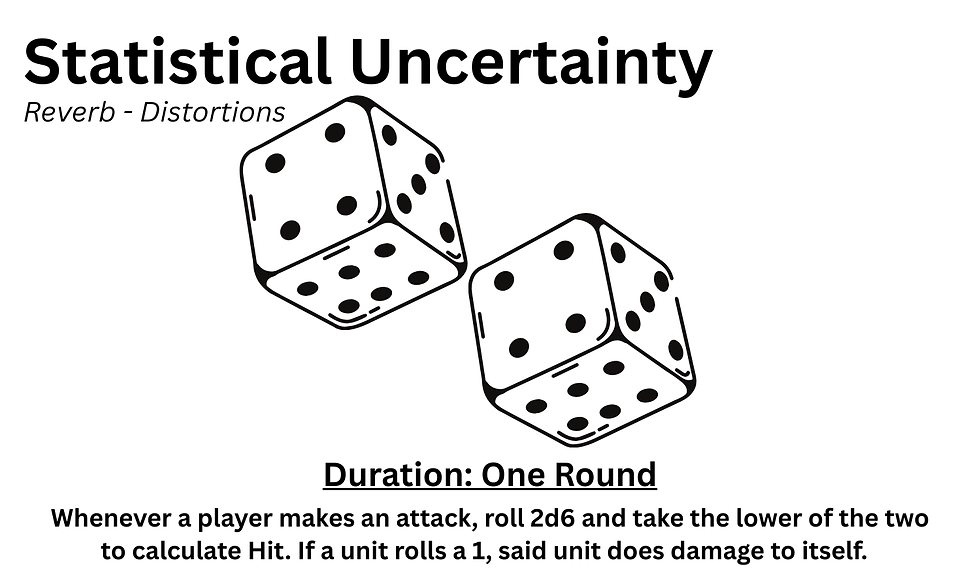
So I went about changing the effects or clarifying the effects of multiple Reverbs in line with the changes above. Only a small handful of cards were removed from the deck, mainly because they referenced systems no longer in the game. For the most part, the second iteration of Reverbs is the same as before, only clearer and with some of the redundancies picked out.
Furthermore, Reverbs have been separated into three major types: Boons, Complications, and Distortions. Boons are the simplest Reverbs in the deck, offering only flat buffs and are positive additions for all players.


Complications, on the other hand, are less straightforward. These Reverbs focus on altering the board state physically, either by adding new Sub-Objectives, creating more Forbidden Fruit, or causing Sub-Objectives to apply a Condition to anyone within them. In short, Complications add something new to the board that could either be useful or hindering to a player, and resolve fairly quickly.


Distortions aren’t things players can ignore. Even the ones that don’t stick around for the rest of the game still make their mark by the time they finish resolving. These Reverbs are the most dangerous and the most impactful. When a Complication enters, there is a possibility that the board state will change. But when a Distortion enters play, the board state is sure to shift.
These separations were added to help distinguish Reverbs for both myself and players alike. Now, I have this overall design philosophy for each type of Reverb, and players have a way to better reference Reverbs during gameplay. This has made creating new Reverbs easier, as I can better slot them into a power bracket early on, while also allowing me to create more specific spells and abilities that target certain types of Reverbs. The language within these cards was also altered for consistency, so that players can get

familiar with how the rules of the game are expressed; similar to how, in MTG, there is a big difference between “Target Permanent” and “Target Creature,” with one being made more powerful than the other just by changing one word. An idea that I would also like to play with, but that is covered in the next section.
—
Reworked Factions
The other significant change made in this iteration was bringing the individual factions closer to their desired roles and identities, based on how players have perceived them so far. Now, due to the curated nature of each of these changes, each faction will need to be discussed individually; however, they do have some overlap,, which I will address first.
Spell Hand Rework
A common pain point among play testers was choice paralysis. Originally, I wanted players to have access to all the spells and abilities they would have from the get-go, so no one player would feel locked out of their game plan by a bad draw or faulty hand. This, in practice, led to players ignoring most cards completely, as it presented too many options without a firm enough context for their application. So, the spell hand was limited to five cards, and the rest were shuffled into a deck; however, a faction's bread and butter spells, the ones that help build their momentum, are placed either in their starting hand or are built into their faction’s support type unit. This way, players will start the game with the tools that will create the baseline for future plans while they draw into power plays.
Units altered to fit their faction.
Segwaying in from that last section, in previous iterations, all three factions had the same units with the same abilities. This was done to get an overall baseline for each type of unit, with the Commander giving the faction its unique identity. However, the Commander can only go so far, and they need to be supported by units that also help play into their identity. To that end, the overall structure of DPS, Tank, and Support remains, but is adapted more to fit within each faction’s definition of each of those roles.
Looking at just the DPS units for each faction: Brawl remains the same as before, being able to attack twice and potentially do more damage with critical hits — but Swarm and Plot have been taken in different directions. Swarm DPS is more focused on being a threat when attacked into, as Swarm’s goal is to control objectives through their higher Intimidation and numbers, while making it difficult for other players to disrupt their positions once formed. While Plot DPS is more focused on allowing other units in their faction to make attacks when it's not their turn, letting those units make attacks without using their action, so they can use it for something else.
This repeats for each of the major unit types in the game, adding to the faction's identity and play style, while also making it easier for players to reach the goals those factions want to achieve.
Brawl Changes.
Brawl, now called Chimera Core, is focused on rush-down tactics, direct combat, and kidnapping. Brawl players previously pointed out that it was difficult for them to engage with these goals when they lacked the tools to get into combat quick enough to challenge either of the other players. To that end, Chimera Core now has a faction-wide ability that allows them to dash as a Free Action, and on the first and last rounds of the game, they can dash for their full movement and not just half. This way, they should be able to get into combat with either player they choose to target, or the Automatons, while still having actions available to start combat.
They have also been given spells like Breakthrough, Bump, and Re-roll to help make sure they can land attacks and deal damage when they do, while also having the option to blow through obstacles instead of having to go around them. They can also create new allies with the spell “Liberate!” which can be found in their spell deck or on their Support type units. “Liberate!” either has a chance to create a new allied unit or it can be used to add a new line of rules text to an existing ally based on their Commander’s Inherited Traits: special rules for Chimera Core Commanders.
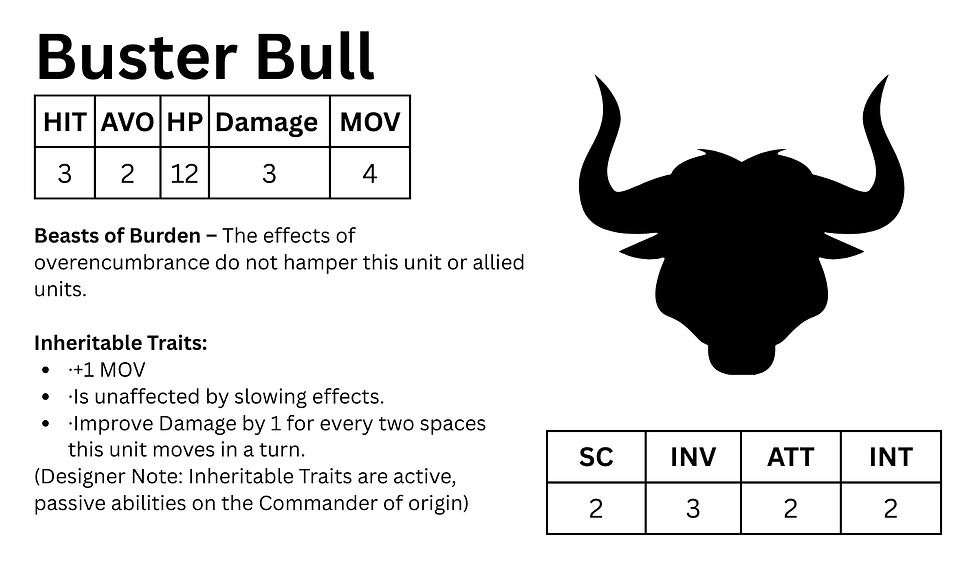
The Chimera Core Commander, Buster Bull, has three active passive abilities that apply perpetually to him at the start of the game. But, using “Liberate!”, you can copy one of those passives from Buster Bull onto one of the units under his command, granting them either:
+1 MOV
Unit is unaffected by slowing effects.
Improve damage by 1 for every two spaces this unit moves in a turn.
Buster Bull also nullifies the penalties for overencumbrance. So units led by him can pick up and carry whatever they want without fear of being penalized in combat.
The Chimera Core now also starts along one of the game board’s faces, and once their recall zones open, all of the board faces become exit points for this faction. Meaning they only have to reach a board edge to leave play, instead of having to hoof it back to their original spawn. Allowing for the Brawl player to get into and out of combat easier, while also giving their opponents options to hinder their escape by manipulating the board with obstacles or other AOE hazards they may be forced to cross. This way, Chimera Core players can more easily get to objectives, bust through obstacles, and achieve their missions of KOing and removing player pieces. They should now become the pace car for the rest of the players; one they need to either get in front of, or sabotage before it can pick up too much speed.
Swarm Changes
Swarm, now called the Empire of the Immortal Sun, is focused on taking and holding objectives. They want to replace Automatons as the largest board presence. However, previously, Swarm players were unable to reach objectives and hold them down. Nor did they have the chance to utilize Swarm’s ability to make more units by controlling Objectives. To help elevate this, Swarm’s starting spawn was changed. Previously, they started on a fixed spot on the map. Now, they choose two objectives they want to spread their units across, giving them that foothold from the get-go. They are then incentivized to take more objectives and root out the Automatons, as their Missions now grant them VP for every Automaton they remove. And if they manage to remove an AI Spawner, they create a new Sub-Objective with more Forbidden Fruit.
Empire units also have a unique way of attuning Mana and utilizing Forbidden Fruit, which plays into their more defensive play style. During attunement, at the end of a Round, the Empire Commander gains Mana equal to the amount of Forbidden Fruit on an Objective they control without having to have it in their INV. This way, Empire Commanders will always be able to cast their most powerful spells if they maintain control of the objective. They can also trade Fruit for more units on an objective they control, allowing them to strengthen their board presence at the cost of their spell casting ability. Giving these players more options for how they want to use board resources, while also giving their opponents a way to disrupt their momentum without engaging in direct combat.
To further facilitate this, they have been given spells like Resist, Retort, and Shift: spells that either make it more risky to attack into Empire units or that allow them to move Obstacles around to hinder their opponents. Their units are also more suited for holding, rather than taking objectives; they are they can counterattack for free or apply debuffs while on an Objective. And while lacking unit spells, Swarm units do regenerate HP during attunement, making it all the harder to depose them.

Their Commander, The Last Empress, also helps lock down objectives with her Passive: Supreme Authority. An ability that gives her and her allies immunity to the effects of Reverbs if she is on an objective controlled by the Empire. It is though her that players can trade Fruit for more units, making her a key component in maintaining board control. Something that should now be easier for these players to accomplish, becoming the new hindrance for other players in place of the Automatons.
Plot Changes
Finally, Plot, now called Creatures of Havoc, changed the least in this iteration; however, they were still tweaked to fit within the overall changes made to the game. Plot was the most stable of the three factions previously, and Plot players were playing to their faction’s strengths. But they did note that certain aspects of the faction were over-tuned. Their passive, which generates one Mana whenever a Reverb is drawn, could combo into an infinite mana loop with Tempt Fate, nullifying the cost of the spell. They also did not engage with the Stack the Deck spell that would have allowed them to remove or add Reverbs to the Reberb deck. I failed to clarify why that was, and if this pattern repeats in the in the next testing session,, I will be sure to ask. As of now,, the changes made to the Creatures of Havoc have been more along the lines of balancing out their kit so that no one part overshadows the others.
First off, their passive — and Stack the Deck — have been altered in accordance with the changes to Reverbs. Now, Creatures of Havoc players only gain Mana off of Complication, Distortion, and Plot Reverbs. So they are now less likely to get the infinite mana loop without first trimming out the Boons in the deck. And they can now cast spells on other players' turns as a Free Action, allowing for better counterplay when it’s not their turn. The problem I see now, however, is that they are the most mana dependent faction in the game, but may struggle to consistently gain enough of the resource to be effective. Something to keep an eye on during testing.
One such way of getting more Mana is from their version of a Disrupter, which can steal resources (Mana included) from other units when they land attacks. They also can’t be targeted if they didn’t attack on their turn. So if combined with the Creature of Havoc Attacker, who allows nearby allies to attack with them, then these players can fish for extra Mana without endangering the Disrupters. However, this ability costs Mana to use to begin with, so there could very well be room for improvement here.
The Commander, Kōng, has been reworked to better incentivize altering the Reverb deck. Not only does he become stronger with each Plot or Distortion Reverb that enters play, but he can now pay Mana to amend any Reverb that targets multiple players with [except Creatures of Havoc]. This could probably be changed to [except X player] to give the ability more versatility — especially given that it costs more to amend a Boon than a Distortion. But again, something to keep an eye on.

Finally, the spells given to the Creatures of Havoc focus more on messing with other players, either by giving them junk cards in their spell decks or stealing cards from their hands. They also have a few spells that apply conditions, making combat harder for other players. So while they will most likely be the focus for the next Round of iterations, as of now, they are closer to the trickster faction I originally wanted them to be.
Spell Reworks
Something the Plot player mentioned after pulling off the infinite mana loop with Tempt Fate was that “this [Tempt Fate] can not be in my starting hand.” His logic was that it was too big a power piece to have access to from the word go, and too easy to pull off, leaving other players at a disadvantage as they didn’t have a chance to do anything to stop him. He recommended that tuning down how much free Mana Plot generates would help, something covered already in the Creatures of Havoc section above, but, as also discussed above, there was also the problem of choice paralysis.
Players simply had too many options in their hands from the start, and nothing to help guide their eyes to some kind of game plan. In Magic: The Gathering, for instance, a good starting hand of seven cards is 2-3 lands and then 4-5 cards that you can play ‘On Curve,’ meaning you can play something each turn as your mana base expands. This way, players can get a sense of what their next few turns look like just from these seven cards. They know how much more mana they need to draw into, what creatures are available to them, and what spells they could play on other players' turns to slow them down. Granted, the random nature of Magic does sometimes leave players with unplayable hands; however, it is still better than spaying a new player’s entire library out as their hand and expecting them to know what to play.
There needs to be some sort of control over what each player has access to, spell-wise, so as not to overload them. Spells, in a perfect world, should help guide the player along their faction’s play style, along with the units and commanders. However, in that perfect world, I also don’t want players feeling like they missed out on a play because they drew into a ‘bricked’ (useless) hand. So, while spells have been shuffled into a 20ish-card deck, there are some key alterations to the context to help remedy bricking.


For one, each player, depending on their Commander, starts with a set hand of five cards. These starting cards are the bread and butter of the faction and will help said faction generate and/or keep momentum. This way, players get a better idea of what their faction is better at and can form better plans of action accordingly. Spells are also discarded after casting, hopefully making players less dependent on certain cards, while also preventing infinite mana loops from occurring every round. But players are not completely at the mercy of the draw, as long as they meet their Empowerment Goals.
Empowerment is a new system that determines how many cards players can see off the top of their decks and how many they can draw per turn. Each faction has a different Empowerment requirement, tied as well to their faction identity. As long as the player meets those requirements each round, their Empowerment rises or stays at its current level. This way, if players are playing to their strengths, they are rewarded with more consistent draws and the ability to plan ahead more effectively than their opponents. While their opponents can also hinder Empowerment by preventing them from achieving Empowerment in the first place. Chimera Core, for instance, gains Empowerment based on the number of units in its army over the starting number. So as long as other players can keep them below that number, their Empowerment remains low. On its face, it's a system that I like, but will need some fine-tuning in iterations to come, just so it doesn't become something players can abuse to hard-lock opponents out of good draws.
Conclusion
A lot got added or changed in this iteration, and that excites me. Yes, there is more work to be done, and with every new system added, the overall design problems become more complex. Yet, at the same time, it creates new opportunities. I can now have units and spells that mess with spell decks and hands, Units that relay on line of sight, Reverbs that affect Empowerment, Obstacles that can be walked through but apply status conditions, etc., etc. The foundations are finally coming together, and once they do, I can start to get really weird — and I’m looking forward to that.
Comments